DORDRECHT
This city 100 km southwest of Amsterdam was close enough to visit on a day trip by train. Together with Zwijndrecht, the city across the river, the population of the area is 190,000 people. It's location at the confluence of three major rivers made it a trading center that connected the finacial centers of Rotterdam and Den Hague to the north with delta cities of Breda and Antwerp to the south. Historic Dordrecht is a network of narrow roads bridging canals that meander between medieval buildings.
The town's 13th century der Grote Kerk or "the big church" is visible from the water at the western harbor to welcome sailors home (or to remind them that god was watching them). The play between old and new in this town is delicate but not reverent or conservative. At the center of old town is a town plaza surrounded by modern shopping.
The Dordrecht Museum by Dirk Jan Postel is a crafty juxtaposition of glass and metal amidst the brick and wood of the neighboring buildings.
I ventured outside the second canal to see the token Dutch windmill that dates back to 1713 and stands between a 1990's apartment building and a turn of the century (20th) row house building.
The 1939 Theater Cafe addition by Sybold to an 18th century neo-classical J. Verheul building shows that Dordrecht appreciates both new and old.
Today, planners have put in motion a scheme to develop the waterfront area west of the Hugo do Grootlaan bridge. This area is called Maasteras. It will comprise 80 acres on the north and south side of the Oude Maas river. It stands as a gateway to the two cities with proximity to historic Dordrecht and access from major roadways and the central train station.The north will be predominantly educational buildings for the Zwijndrecht and Dordrecht Colleges and office buildings. The south is planned as housing, offices and green space. Divided by an on ramp for the motor way, tunnel access for a second motor way and the base of the bridge itself, the southern site will pose some complex challenges for designers not least of which is the reroute of transport for hazardous cargo currently running through this zone.
ROTTERDAM
Image from OMA
After 10 years in the drawer, the city of Rotterdam dusted off OMA's drawings for the 160,000 m2 De Rotterdam complex and started construction last year on Wilhelminapier. Now rising several floors out of the ground, the mass required to pull off the city within a building concept is obvious. Piano's design for the KPN Telecom building in 2000 was a creative counterbalance to Carlatrava's Erasmus bridge. The two structures stand adjacent to one another in mutual admiration of their structural prowess. The new complex tends to make the slender column supporting the canted facade of KPN look more like the legendary dutch boy Hans Brinker with his finger in the dyke.
The day for visiting Rotterdam couldn't have been better. The sun was shining and warm, it was the annual World Port Days and Wilhelminapier was the epicenter of all the action. Plans for this abandoned port have been in the works for more than a decade.
Montevideo
Esplanade at New Orleans
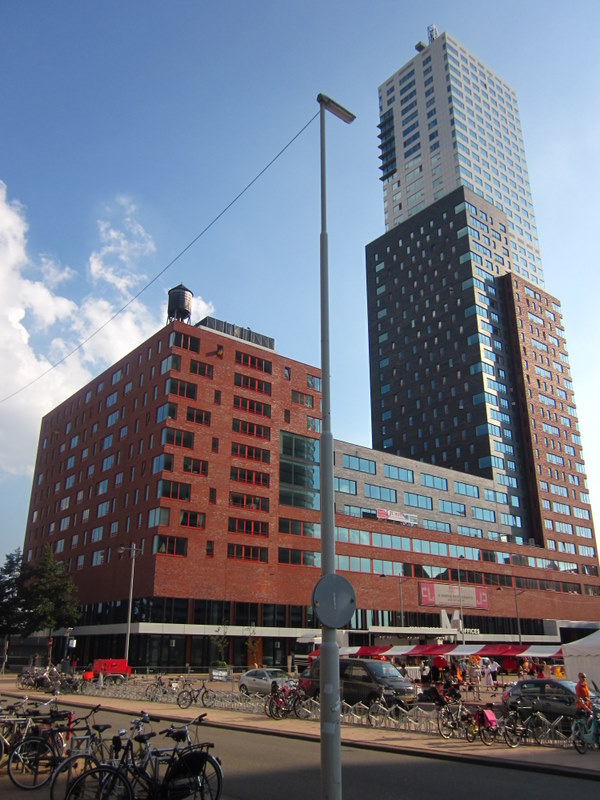
The New Orleans tower opened recently and at 160.5m is just 4.5m shy of the Maas Tower down the street, now the tallest building in the Netherlands. Five more buildings named after American cities are designed, ready for construction when the economic tides start to shift once more.
If you are in Rotterdam, visit the NAI (Netherlands Architecture Institute.) They have a top notch architecture book store, rotating and permanent art and architecture exhibits and self-guided tours of the Sonneveld house across the street. This is the best part as the Broek and Van der Vlught designed building is immaculately restored, including replicas of Van der Vlugts furniture designs.
If you’ve paid any attention to architecture rags, blogs or
lectures in the past decade it has been hard to miss the eye popping projects coming
out of the Netherlands. Rem Koolhaas’ OMA helped pave the way for the next
generation of designers by demonstrating that nothing attracts a tourist quite
like a sleek new building designed by the hottest new architect. The reality is
that the building boom of the last 15 years has enriched Amsterdam’s image and
carried on a tradition of fostering great design and not shying away from
taking chances.
HISTORY
Het Schip (the Ship) is DeKlerk’s master work. It is located
in a cluster of his other residential buildings in the Westerpark area
northwest of the city center. Taking cues from his western counterparts Wright
and Macintosh, DeKlerk designed everything in this building from the door knobs
to the type face on the graphics. He gave birth to the Amsterdam school and raised
it on a hardy diet of socialism. He designed for the working man and put him on
equal standing with his employer. Het Schip was designed with a post office at
the northwest end. It was unusual at the time for a post office to be located
in a working class neighborhood since it was common for workers to neither read
nor write. It included a banking service for cashing and depositing checks. DeKlerk’s
aim was to put an end to the cycle of working 14 hrs/day for seven days a week,
then drinking away the earnings on pay day. The post office is now a museum
where well-informed docents provide scheduled guided tours.
The residential red brick buildings with organic expressive
forms and simple ornament throughout the city speak to DeKlerk’s influence. The
school was built on principles of redefining architectural style and righting
social injustices. This later gave rise to replication of the style.
Sonnerveld House, Brinkman / van der Vlugt - Rotterdam, NL
Rotterdam Van Nelle Factory, Brinkman / van der Vlugt - Photo by F. Eveleens
Under the
influence of the Bauhaus movement, architects such as Jan Duiker, Berlage, Rietveld
Johannes Brinkman and JA van der Vlugt lead a functionalist movement exploring
extensive use of steel and glass, the most notable of which were Duiker’s
Sanatorium in Zonnestral and Brinkman / van der Vlugt’s Van Nelle factory in
Rotterdam.
Much of The Sanatorium was recently beautifully restored. Portions
of the interior remain unfinished. After touring the interior, Duiker’s mastery
of the trade in his short career is clear.
Willem Dudok was a
prolific and largely self-styled Dutch architect. Between 1920 and the early 1970’s
he borrowed stylistic moves from the Amsterdam school, the functionalist and Viennese secessionist movement and even elements of Frank Lloyd Wright’s prairie style.
Following
principles espoused by LeCorbusier’s manifesto, starting in the early 1960’s Aldo VanEyck and then Herman Hertzberger built
the structuralist
movement exploring a more humane urbanism and structures of concrete and steel
with distinctive humanist elements.
The open stairwell of Hertzberger's Willemspark Montessori School serves as a gathering space for the surrounding classrooms. The design takes advantage of every corner of this multi-level facility with storage containers, desks, seating or shelves. The design was flexible and adaptable to the needs of the future. In the late 1980’s Rem Koolhaas and his contemporaries brought a design under deconstructivist influence that remains visible in in the designs of
today's architects.
After the shipping industry transitioned from mixed cargo to
container shipments in the 1960’s ships grew and trains replaced ships for
personal travel. Shipping companies moved their terminals west of the city and
the east docklands were largely abandoned in the 70’s. These docklands east of
the Central station were an opportunity for the City of Amsterdam to keep
businesses and higher income families in the city. The City implemented
programs to promote well-designed, mixed-use, socially mixed, sustainable
buildings. This program broke a pattern of urban infill with low-income residential
buildings. The result brought more revenue to the city, provided more livable
communities and served as a breeding ground for talented, young Dutch architects.
The Library by Joe Coenen, Conservatorium by Architects CIE
and NEMO Science Center by Renzo Piano in the Oostelijke Handels kade serve as the
gateway to all things east of Central Station. Along Piet Heinkade east of the
library is the Music Center by 3XN, Movenpick Hotel by Claus en Kaan and the cruise terminal.
Further east on this road are old warehouse building conversions housing
numerous restaurants, clubs, offices, galleries, studios and an art school.
Esplanade on Java Island
Soeters Van Eldonk Ponec architecten were responsible for
the master planning of Java Island. Whimsical one-off bridges cross four canals
that divide the island. Clusters of residential courtyard buildings use tree
lined esplanades for pedestrian and vehicular waterfront access and quiet, secure
courtyards on the interior for balconies and playground areas. Building on the success
of this project the architects went on to plan the Sluseholmen
project in Denmark.
Master planned by Amsterdam’s West 8, the Borneo/Sporenburg development uses
the combination of water, safety, security and ease of access to downtown to make
this area attractive to young families with jobs in the city. To give the area
character the Borneo home owners were able to design their own homes. The
result is a funky, eclectic collection of homes right on the canal.
PLANS FOR THE FUTURE
NDSM Werf - Just when I thought I had a grasp on where the
action was, my host tells me about this place where there are warehouses in an
old shipping/dockyard area called NDSM Werf. It’s across the water but it’s
easy to get there with one of the free ferries that run every 15 minutes. There
was only time to see the exterior of the warehouses, but what strikes you as
you approach the area from the dock are not the warehouses that artists have
consumed for studio space, but the colorful freight containers stacked five
high and thirty wide to house them. Built as dorm housing, these can be rented
for the equivalent of $600/month (a fraction of the going rate in Amsterdam for
similar sized units) and they are right where the students want to be.
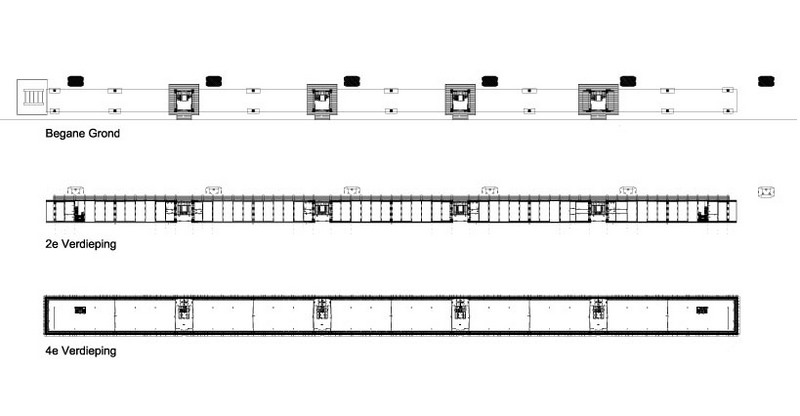
Plan and section drawings from OTH Architects
As is
usual with areas of the city where artists dwell, word caught on and the
businesses and restaurants started to set up shop. One of them, an
advertising firm called Dawn BV, is leasing space in the Kraanspoor Building. It has to be one of the sexiest offices on the planet! The architects Ontwerpgroep Trude Hooykas BV
propped a glass box on stilts over an existing mobile shipping crane rail
superstructure. At 270 meters long and 12.6 meters wide, it’s appropriate that the
building took on a train-like proportion. The building is like a super model for
me - its looks are all that matter. But scratching the surface this building
has much more behind that sexy body, it’s smart too. An all glass building
needs some protection from the sun, so the building is surrounded by a dual
façade of operable tinted glass sun shades on the exterior and wood louvers on
the interior. It utilized the existing structure and crane access stairways.
This solution uses existing industrial structure and infrastructure to provide
prime office space. It supports the revitalization of a fringe city development
and does it without leaving a footprint.
Ijburg - The 1996 brain
child of urban planners Palmboom & Van den Bou, IJburg is a new district east
of the docklands. It is the next wave of development for the city. Seven
islands with 18,000 units are planned for some 45,000 residents. These are the gray and cream colored islands pointing to the upper right in the image above. The first
three islands are nearing completion (the gray islands) with homes for 15,000 residents. Phase 2 - the cream colored islands - was
rejected by the State Council for environmental reasons (can you even imagine
the US EPA ever approving building a new island?) but was resubmitted in 2010
and is awaiting approval. Planning includes four of the artificial islands that
will provide 9,000 units and be constructed in several stages.
THE RECIPE
Within each of these developments there is a pattern of
elements. They each include a list of key ingredients:
1.Development started on the foundations of an
existing, now defunct industrial site. Once success of the area was proven, the
city planned for (and built) additional man-made islands for expansion. From
and environmental perspective, the act of constructing new islands to handle
growth seems to me a slippery slope.
2.Existing building reuse is not a pre-requisite
but is common.
3.Businesses, retail, hospitality and residential
programs are included in each area.
4.Tram and/or bus service connect each area to the city center.
5.There are clear pedestrian, bicycle and vehicle
pathways connections to and within the development.
6.Project areas are no more than ¼ mile from recreation
areas.
7.Planning incorporates civic or cultural
institutions (i.e. schools, libraries, theaters, cinema.)
8.All have abundant waterfront access.
ENERGY AND CLIMATE
The focus of the development discussion above is largely on design,
revenue and growth accommodation. Each is also highly regulated in terms of its consumption and environmental impact Amsterdam and the Netherlands are leading the
way with new technology and practice in areas of Energy production, CO2
emissions, waste management and public transportation. The Netherlands have signed on to the EU energy policy and Amsterdam has by 2025 targeted a reduction in CO2 emissions to 40% of 1990 levels. According to an EU European Commission report, they aim to make get there with multiple forms of renewable energy - wind, solar, hydro, bio fuels and bio waste.
A new waste to energy program is diverting trash
from expensive landfill sites and is converting it to clean energy in the form of power and district heating. Public bins separate glass and
cardboard for recycling but by and large the rest goes in the trash. Consumers
do pay a deposit on glass, aluminum and plastic bottles to discourage tossing
them but according to this blog
and the energy producer AEB
the metal is recycled after incineration. The buring cleans and purifies the
metal making it more valuable on the market. At 32% efficiency the power plant
is well below the most efficient coal fired plants and 1/3 of the peak
performance of DONG Energy’s power/district heating plants in Denmark.